
$6.25 Million Boost for Youth Substance Use Prevention for Seven Counties in North Carolina’s Coastal Region.
Since the Light Paper: Addiction was released, an exciting development has occurred in the realm of mental health and substance use services, specifically for youth, surfaced through a North Carolina Department of Health and Human Services (NCDHHS) press release. The role of state-supported initiatives emerges as a beacon of hope and resilience in navigating the labyrinth of mental health crises and substance dependency in North Carolina.
On May 9, 2024, NCDHHS announced North Carolina was 1 of 12 states awarded $6.25 million dollars from the U.S. Substance Abuse and Mental Health Services Administration to provide seven counties with youth substance use prevention. The funding comes as part of the National Drug Control Strategy. NC Health and Human Services Secretary Kody H. Kinsley was quoted saying:
“Prevention and early intervention are important, especially for our young people. With more than 62,000 youth struggling with substance use in our state, there is an urgent need for services that prevent those at risk from reaching a point of crisis.”
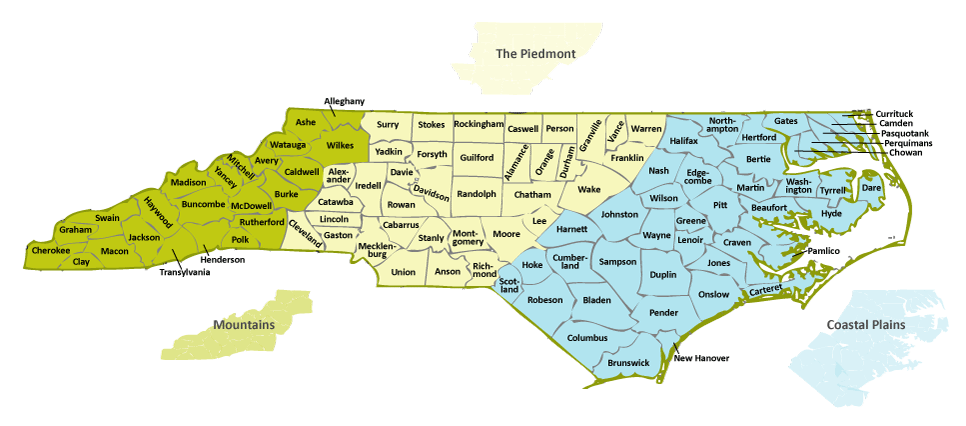
The seven counties receiving support and funding are Duplin County, Halifax County, Hoke County, Martin County, Robeson County, Tyrrell County, and Washington County. These counties are reported to be experiencing high levels of economic stress and higher than average levels of substance use among youth and young adults, especially those identifying as a racial or ethnic minority. The NCDHHS article states the money will help local entities with implementing strategies to enhance protective factors and reduce risk factors for substance misuse.

Want updates on upcoming Lightbulb Moment articles?
All seven of the selected counties are geographically located in North Carolina’s Coastal Region, which can be seen from the map below taken from NCPedia:
This raises concerns about the inequality of health in North Carolina. A NC Health News article posted in 2022 by Rachel Crumpler includes the following graphic from the Annual County Health Ranking:
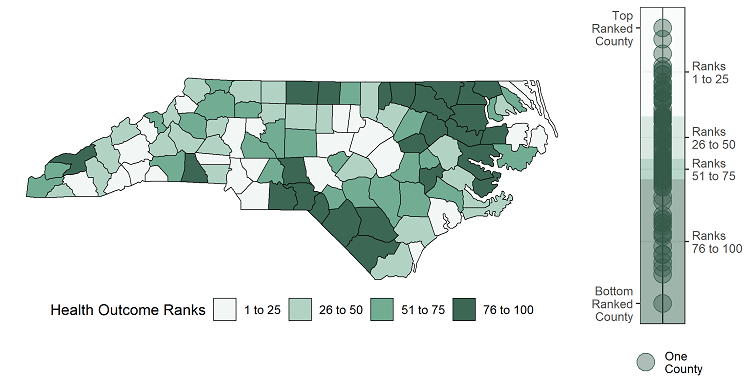
This graphic demonstrates how North Carolina’s coastal region, by many standards, fares worse than the Piedmont and Mountain regions. Jaymie Baxley explains in a NC Health News article how the NC Rural Center determined 78 out of the 100 counties in North Carolina are rural due to their population density. However, the CEO of NC Rural Center,Patrick Woodie described how even within rural counties in North Carolina, there are large disparities in health, with Western North Carolina faring better than rural parts of Eastern North Carolina.
Hopefully, the funding from the US Substance Abuse and Mental Health Services grant will alleviate some of the health burden in the Coastal region, increasing overall wellbeing for younger populations and communities.
The 2024 National Findings from the University of Wisconsin Population Health Institute and Robert Wood Johnson Foundation found counties in the Triangle of North Carolina, which includes Wake, Durham, Chatham, and Orange County, have some of the best health outcomes in the country. An article from AXIOS Raleigh explained how Wake, Orange, and Durham counties all have higher life expectancies and lower rates of premature death than the rest of the country. The article also highlights that these results are in stark contrast to the rest of North Carolina, with the report also revealing that 54% of NC’s counties have average or below average health factors, with 23 of the counties being in the Eastern/Coastal region of NC. The health indicators included in the report are comprehensive, ranging from social to economic factors.
While the funding for youth substance use prevention provides a monumental step forward in the realm of mental health and substance use services, it may be time for North Carolina to more deeply analyze the structural barriers in place contributing to a wide gap of health outcomes across the state, particularly in the Eastern region of NC.
If you have any questions or comments about the content in this Lightbulb Moment article, please get in touch with our Research Associate, Madeline Attianese, at [email protected].