
Make your voice count and reduce Election season stress by using key strategies.
With less than a month until Election Day on November 5th, now more than ever news stations, social media, and articles are pumping out information about candidates and voting information. An abundance of information can make it difficult to understand what is most important to pay attention to, where you should get information from, and what you need to know for when November 5th rolls around. In this Lightbulb Moment we will look at why voting matters and important information you may not know but need to know for Election Day.
*For reference, this paper will use the term ‘partisan,’ specifically nonpartisan. Partisan is defined as being a strong supporter of a party, cause, or person. Conversely, nonpartisan is defined as not being connected with a group or a political party.
Why Voting Matters
The Pew Research Center posted an article about how around seven out of ten adults think it is essential to vote in elections to be a good member of society. For the 2020 presidential election, about two-thirds of the voting-eligible population turned out for the 2020 presidential election. A main deterrent of voting is the myth that an individual’s vote doesn’t matter. Nonetheless, many elections are much closer than people realize. The non-partisan (unbiased, impartial) site Your Vote Matters speaks to how the closest Presidential election in US history, the 2000 race between George Bush and Al Gore, came down to margin of just 537 votes. More recently, in 2016, the election between Donald Trump and Hilary Clinton came down to 107,000 votes. While this seems like a large number, in terms of the population of registered voters, the number is small in comparison.
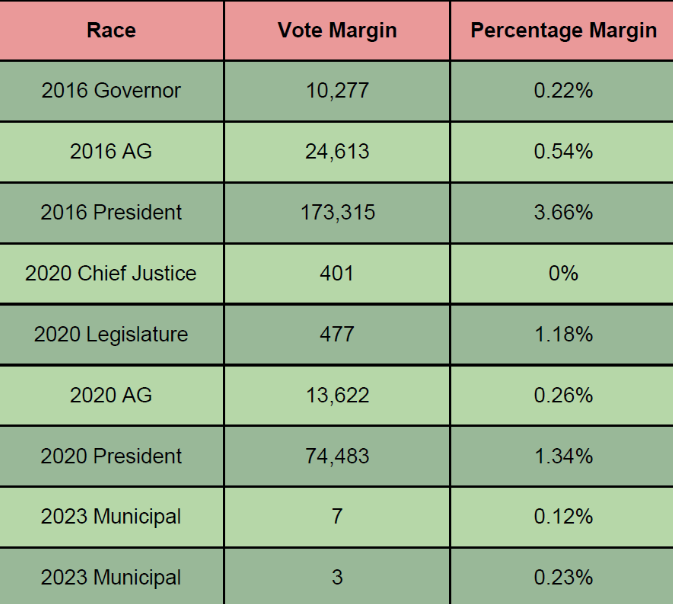
In North Carolina, voting margins are historically small. From the North Carolina Center for Nonprofits training, “(Almost) Everything Your Nonprofit Needs to Know about the 2024 Election,” Lauren Trustman Noyes explains how the voting margins in NC tend to be small and provides this chart for context:
Want updates on upcoming Lightbulb Moment articles?
Small voting margins emphasize the importance of even a single vote to change election outcomes. Even one vote could be the difference between a candidate winning or losing, especially when it comes to local elections. For example, according to NPR, a Virginia House of Delegates race ended in a tie of more than 23,000 votes cast in 2018. The Republican winner, David Yancey, was declared the winner through pulling a name out of a film canister. In 2017, the Vermont state Democratic primary was determined by a single vote out of 7,400 cast. Therefore, in a state that experiences relatively small voting margins, your vote could make all the difference.
Furthermore, the American Medical Association passed a resolution in 2022 acknowledging how “voting is a social determinant of health.” Healthy People 2030 defines a social determinant of health as the conditions in the environments where people are born, live, learn, work, play, worship, and age that affect one’s health and overall quality-of-life. Physician’s Weekly shares how research has found that people who vote tend to report better health outcomes than those who do not. The Network for Public Health Law expands this idea by saying that voter access and engagement acts as a pathway for advancing health equity. The University of Berkeley speaks to how, through voting people can contribute to decisions that affect their communities in terms of access to healthcare, resources, and overall well-being. Therefore, voting is a key part of public health and a way for communities to be an active participant in the decision-making process.
Important Information to Know for Voting
ABC 11 Raleigh&Durham highlights a new study from the American Psychiatric Association showing how anxiety is up 43 percent in Americans from last year, which three quarters of people say largely is due to the election. Dr. Megan Pruette, an associate professor of psychiatry at University of North Carolina at Chapel Hill, says that voting is one way to ease people’s anxiety and give people a sense of control over the unknown of election season. Here we discuss a few things to at least ease your anxiety when it is your time to vote.
Elections are an “open book test.” Filling out a ballot on Election Day often evokes feelings of being back to testing days. However, while most people see the day as something you must memorize the facts to make an informed decision, you can bring materials to help you fill out the ballot exactly how you would like. The North Carolina State Board of Elections explains how NC voters are allowed to have phones or electronic devices while they are voting if they are not taking videos or photos or communicating with other individuals. Nonetheless, you can use it to look up candidates’ names and their positions on issues if you stumble on names you are unfamiliar with. One can also use voter guides, sample ballots, and notes on any candidates to the polls. If you want to double check the rules at your local election office, click here.
There are hotlines available for voters to address voting day concerns. According to NC Voter, if you have issues with voting on Election Day, you can call the National Election Protection hotline at (866) 687-8683 or the NC hotline at 888-OUR-VOTE. These hotlines are equipped with attorneys who can respond in a timely manner to concerns from voters and anything impeding voting ability and rights.
Local and State elections are just as important as Federal/National elections. While ample attention is given to federal elections, local elections affect every aspect of your life. The Scholars Strategy Network’s Election Protection & Enhancement Program highlights how decisions about how schools are run in your area and how people in your area are policed are made at the local level, while decisions about how schools, social services, and housing are funded are made at the State level. These elections often do not get as much publicity and coverage as federal elections but have tremendous power over individual and family well-being on a day-to-day basis.
Nonpartisan information is available. According to a report from a Gallup/Knight Foundation Survey 83 percent of Americans say there is at least a fair amount of political bias in news coverage. Three in four Americans say the spread of misinformation online is a “a major problem.” These statistics paint the picture that many individuals in the US have lost confidence in the idea of objective news and media. However, there are resources that exist to identify nonpartisan information. For example, You Can Vote North Carolina is a 501(c)(3) nonprofit organization that is nonpartisan and tries to give voters the information they need. On their website, you can find their comprehensive voter guide. Once you put in your local address, it will populate with all the names that will appear on your 2024 ballot. From here, you can access information on where each candidate stands on key issues and fill out a sample ballot. This is an outstanding way to access objective information about candidates to have a full picture of who aligns most with your beliefs.
Another nonpartisan tool is the Media Bias Chart. According to the Harvard Library, The Media Bias Chart, Ad Fontes has studied 3,600 news sources, 700 podcasts, and 474 TV/video programs to create a chart that rates news sources on their bias rating and their reliability rating. The chart is shown below:
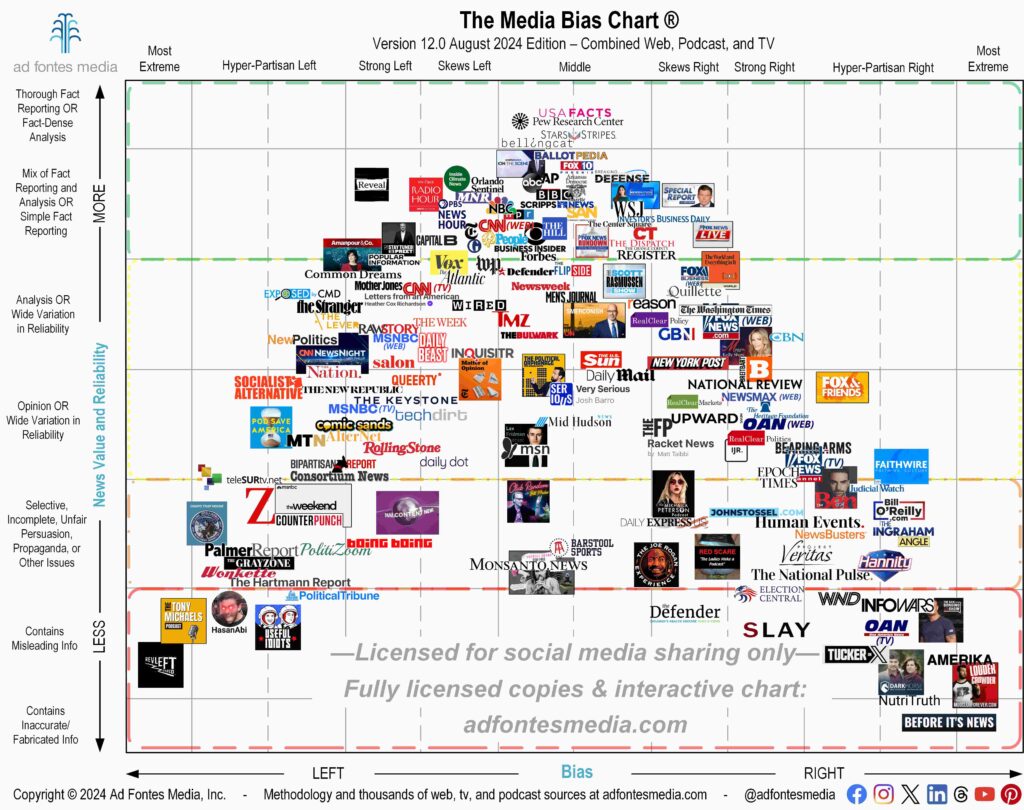
You will see the x-axis shows how bias the news source is, while the y-axis shows where the resources stand in terms of reliability. Reliability scores for articles lay on a scale of 0-64, with 40 being generally good, while bias scores are scaled from –42 to +42, with higher negative scores being more left and higher positive scores being more right leaning. This chart gives you a solid hold on what news outlets you can go to find more objective, nonpartisan information.
Voting can be stressful, but we hope these insights will ease your anxiety and assist you in conquering the polls come November 5th , or as early as October 17th for early voting. Voting is not just a civic duty, but a tool for shaping our future and communities. Every ballot cast is an ode to how someone wishes to see the future of their community, North Carolina, and the United States. Your voice is your vote. This year, make sure it is heard.
If you want or need more general information about voting in North Carolina, visit North Carolina State Board of Elections.
If you have any questions or comments about the content in this Lightbulb Moment article, please get in touch with our Research Lead, Madeline Attianese, at [email protected].