
How to be Hopeful in the Midst of Unknowns
“Aren’t you terrified of what 2025 could be like? Everything is so messed up...”
"I think it will bring flowers."
"Why?"
"Because I’m planting flowers."
-Adapted from an Unknown Author
We Need Hope
Entering 2025, the news has been flooded with negative events and lingers with all the unanswered questions and unknowns of a new Presidential inauguration and a fast-changing world. An article in VeryWell Mind discusses how the human brain naturally tends to focus more on negative information than positive information through what is known as the negativity bias. This tendency towards recognizing the bad things and overlooking the good things is a way to keep our brains safe and, evolutionarily, keep us away from bad, dangerous, and negative threats. However, focusing too much on the negative can have profound effects on our views of the world, how you perceive people, and the decisions you make, leading to undesirable outcomes. This is where practicing hope can dramatically shift mindsets, leading to more promising outcomes and futures. Just like how you can train your muscles to get stronger, the Mayo Clinic suggests that you can train your brain to be more hopeful, rewiring your neural pathways.
Therefore, as we enter a new year, this Lightbulb Moment serves as a step to not catastrophize and lean into cultivating hope. Here we will highlight the brain science of hope and why it is crucial to be hopeful, followed by illuminating what we can be hopeful for in terms of family well-being this year and positive things that are happening in communities in North Carolina.
What is hope? Why is it important?
In these uncertain times, hope is the push we need to keep going. Cultivating hope is more than a coping mechanism—it's a transformative practice that can enhance mental and physical well-being. Frontiers in Psychology defines hope as “a cognitive process by which an individual can identify their personal goals and develop actionable steps to achieve results. It has the potential to positively impact people’s lives by building resilience and can be meaningful experienced at both the individual and group level.”
While hope and wish are sometimes used interchangeably, St. Paul Lutheran Church explains how, “wishes are granted, hopes are fulfilled.” In other words, hope implies a belief that something is possible if we put our minds to it, whereas a wish is more of a fantasy or dream. Arizona State University’s John Parsi, the executive director of the Hope Center, adds how hope is an active process where a person has to take responsibility for their wants and desires and work towards them.
According to the American Psychological Association, this viewpoint of hope originates from psychologist C. R. Snyder, who set the stage for viewing hope as a cognitive process that can be taught, developed, and nurtured, coined as the hope theory. Snyder differentiated between optimism and hope by distinguishing how we can build hope pathways in the brain. The University of Oklahoma’s Hope Research Center highlights the key components of hope:
- Goals: The cornerstone of the hope theory and the ultimate destination to the planned behavior, which can either be short-term or long term. The goal(s) should be clear and attainable.
- Pathways: Pathways are multiple strategies or roadmaps to achieve these goals. When identifying these pathways, an individual can identify potential barriers and evaluate alternative methods to achieving the goal.
- Agency: The mental energy and willpower to pursue these pathways, even in the face of obstacles. When individuals are hopeful, they face the stress and adversity that comes with accomplishing most goals.
The Hope Theory also asserts how establishing hope in our lives can increase our likelihood of accomplishing goals and, subsequently, improve our overall well-being and lead to more fulfilling lives.

Want updates on upcoming Lightbulb Moment articles?
Health Benefits of Hope
In a TIME article, Chan Hellman, a psychologist who’s the founding director of the Hope Research Center at University of Oklahoma, states that hope is a significant protective factor, with our capacity for hope being one of the strongest predictors of well-being. Harvard T.H. Chan School of Public Health addresses the specific health benefits of adopting a hopeful approach to life can have on individuals, including a lower risk of developing cardiovascular disease and other chronic conditions due to their greater likelihood of engaging in healthier behaviors (i.e. exercising and eating a healthy diet). The National Institute of Health highlights how individuals who have higher levels of hope experience lower levels of anxiety. Conversely, research also supports when levels of hope are lower, reported anxiety levels are higher. The Frontiers in Psychology research reveals that hope activates key brain regions:
- Prefrontal cortex for goal setting
- Limbic system for emotional regulation
- Also creates resilience and reduces anxiety.
Overall, hope is routed in tangible ways it improves our health and well-being.
How to Become More Hopeful
Arizona State University lays out a framework for how we can build hope in ourselves and in our communities, which is summarized in the graphic below:
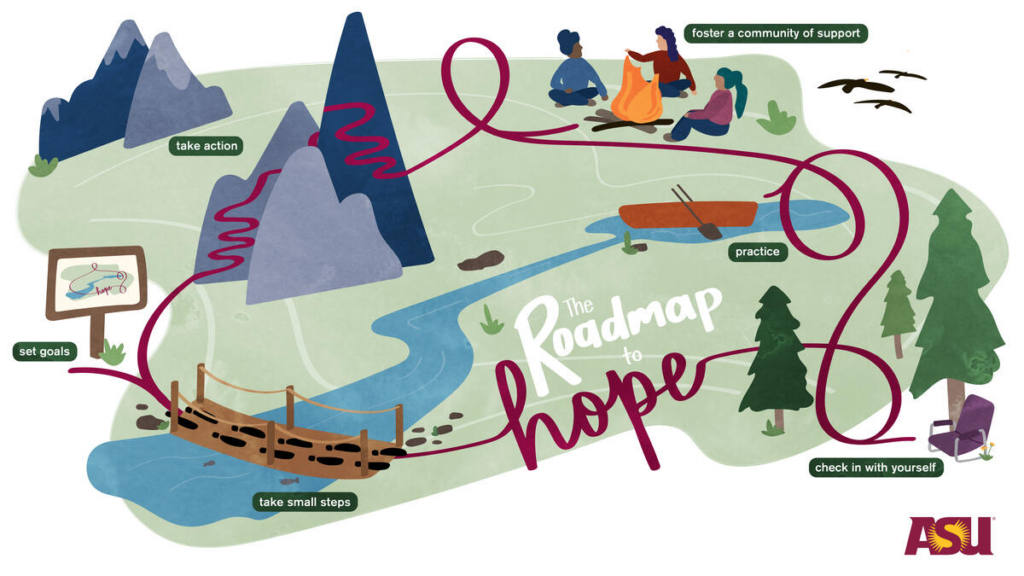
The five components of fostering hope are as follows:
- Take small steps for long-term success. When you have a goal in mind, set aside concentrated time to create a list of actions you need to take to accomplish the goal. From that list, break it up into small actions you can do every day to work towards your greater goal.
- Check in with yourself. To consistently build hope, your goal should make you excited for the future ahead of you and motivate you to reach that future. If this doesn’t ring true, check in yourself with why and adjust accordingly.
- Consider Context. Religion, ethnicity, and overall cultural context can affect how hopeful we are and are encouraged to be. In addition, environmental impacts may hinder one’s ability to feel more hopeful. You should take a moment to consider these factors and how they can affect your pathway towards hope.
- Remember that hope takes practice. You won’t always feel hopeful or even want to be hopeful. Just like some days you may not want to make your bed or do the dishes before relaxing on the couch, hope is a habit that you must practice and develop discipline for the days it doesn’t come as easily. Also, life is unpredictable; sometimes events happen that shake our beliefs and viewpoints. This is where you may have to adjust your goals to align more with your current situation.
- Foster a culture of hope. One huge point that ASU’s team emphasizes is how “hope thrives within communities that support and uplift one another.” People are able to foster hope when they are surrounded by people also willing to practice and engage with the practice.
What We Can Celebrate and Be Hopeful About in NC
Here, we are hoping to take a step towards the last bullet point: foster a culture of hope. A quote from an Unknown author says, “A culture of hope inspires resilience, creativity, and the belief that better days are ahead.” To see that better days are ahead, we need to recognize the strides we have already taken in North Carolina towards a better future. North Carolina, while having further to go to elevate family well-being, also has much to celebrate from 2024. In practicing hope for the new year, here are some of the advancements we should shine light on and remember as we enter 2025:
- Children’s Home Society of NC, our parent organization, was selected to lead the statewide Success Coach Program. Children’s Home Society of NC explains how the Success Coach Program is a voluntary service available to families who have achieved permanency. The program has three key pillars: strengthen, support, and advocate. In other words, the coaches work with families to set family goals, build resilience, enhance communication, connect families with resources, and empower individuals and families ot meet their own needs. By doing this, the goal is to teach new skills to enhance child and family well-being.
- The North Carolina Department of Health and Human Services Division of Public Health talks about how the State has expanded access to overdose prevention programs to over 30,000 North Carolinians, which has been able to distribute naloxone for 15,259 overdose reversals and refer 2,147 participants to treatment providers.
- The North Carolina Department of Health and Human Services Division of Public Health reached nearly 50,000 congregants through Faith Leaders for Life Training Program. This free suicide prevention program was delivered to faith leaders in 37 counties, including rural communities and to those who specifically serve Black, Indigenous, and People of Color.
- The North Carolina Department of Health and Human Services Division of Public Health speaks to how maternal health and safety for incarcerated women was improved through a partnership with UNC Collaborative for Maternal & Infant Health.
- The North Carolina Department of Health and Human Services Division of Public Health states how 63 NC counties participated in a focused program to reduce health disparities and advance health equity in their county to improve outcomes across the state.
- Beacon of Hope in Madison County connects and empowers communities through healthy food choices. Healthy food boxes, fruits, and vegetables are provided to HOP participants that are catered to individual and family needs. This has allowed residents in Madison County to conscious decisions, improving family's overall health.
- The 2024-2025 Olmstead Plan sets to improve community inclusion for people with disabilities. The plan was created by key stakeholders and people with live experience across the state and works towards allowing people with disabilities to interact “to their fullest extent possible” with those without disabilities.
- The Institute for Family celebrated social workers across the state at the 2024 Family Champion Awards. On April 26, 2024, IFF and social workers from across the state gathered at The Duke Endowment to showcase the extraordinary dedication of professionals and advocates who are unsung heroes of communities.
- Medicaid Expansion enrollment has surpassed target a year ahead of projections. Over 600,000 low-income adults are now enrolled with Medicaid. Governor Roy Cooper noted that three-fourths of the eligible have now gained coverage, especially benefiting rural communities in NC.
- The North Carolina Department of Health and Human Services announced in December of 2024 that they have invested $4 million to expand and professionalize family peer support services. The initiative works towards improving outcomes for children and families by, “ensuring that families navigating complex systems have access to support and guidance from someone who truly understands their journey.”
- The SUN Bucks Program was launched in 2024 to provide food assistance to combat child hunger during the summer months when schools are not in session.
While this is not a comprehensive list of all the strides North Carolina has made to create conditions where families can thrive, it acts as a foundation for hope for this upcoming year.
Conclusion
With 2025 fresh and new, it's natural to feel a mix of uncertainty and hope. The opening quote reminds us that the future is shaped by the seeds we plant today. By fostering hope within ourselves and our communities, we can create the foundation for brighter days ahead. In North Carolina, the strides made in advancing family well-being show that progress is not just possible—it’s happening. These achievements remind us of the resilience and potential within our communities to do good for North Carolinians. While we navigate this year remember: 2025 can bring flowers because we are going to engage in the active process of planting them. We can build a beautiful garden.
If you have any questions or comments about the content in this Lightbulb Moment article, please get in touch with our Research Lead, Madeline Attianese, at [email protected].