
Introduction
Professionals and advocates who provide support to families are taught to maintain a ‘reasonable amount of empathy.’ There is a professional detachment you are supposed to adopt when caring for families. EAP India defines this professional detachment as the concept of separating oneself from one’s work to provide space for objectivity and self-reflection. The practice lays in the ability to find a delicate balance between caring too much and too little so professionals can do their jobs well, but not allow their jobs to consume them. While this is a necessary skill and great in concept, it can be easier to accept as theory than as practice. Rachel Naomi Remen explains how, “The expectation that we can be immersed in suffering and loss daily and not be touched by it is as unrealistic as expecting to be able to walk through water without getting wet.” In other words, it is very difficult to expect family professionals and advocates not to absorb the hurt, stress, and trauma the families they serve are experiencing.
What is compassion fatigue?
The Administration for Children and Families provides language for this concept, which is known as compassion fatigue, or secondary stress disorder. They define compassion fatigue as a set of observable reactions to working with people who have been traumatized. The Hahn School of Nursing and Health Science describes the symptoms of compassion fatigue, which can include feelings of isolation, anxiety, dissociation, physical ailments, increased substance use, irritability, feeling overwhelmed and helpless in the face of a clients' suffering, and sleep disturbances. The Institute for Public Health at Washington University St. Louis estimates somewhere between 40 and 85% of helping professionals have developed vicarious trauma, compassion fatigue, and/or high rates of traumatic symptoms. In the ‘Experience’ section of Social Work News, an anonymous social workers spoke to the very real effects of compassion fatigue:
I’ve always believed in the power of empathy. It’s the bedrock upon which my career as a social worker was built, the guiding force enabling me to walk alongside those in need, to share in their moments of despair, and to hold space for their pain and healing. But recently, I’ve encountered a silent adversary, one that crept up so subtly it almost went unnoticed until it enveloped me completely…. compassion fatigue.
In another account of the prevalence of compassion fatigue, Melissa Manganaro, a school counselor recalls:
I just felt my empathy was exhausted. I didn’t know what was wrong with me.
These stories highlight the challenges helping professionals face as they serve families, showing how important it is to address compassion fatigue.
According to the Behavioral Health News, politically stressful and challenging times can add to feelings of compassion fatigue and can further impact our physical, emotional, and psychological health and well-being. In a TEDx UNC Talk, Yakob Lemma, a UNC student speaker describes the phenomenon of activist burnout. He explains that activist burnout occurs when those who want to do positive change are overwhelmed by feelings of exhaustion and frustration because they feel like it is nearly impossible. The Behavioral Health News article adds to this by describing this state as a nagging sense of hopelessness when it comes to the efficacy of political action and advocacy that leads us to fear of an unsafe world for those we serve. When people in organizations experience this, it can lead to:
- Friction among co-workers
- Staff-management tension
- High turnover rates
- Increased absenteeism
Recognizing and understanding the impact of compassion fatigue and activist burnout is essential to supporting professionals and advocates that work with families. If these symptoms and described condition sound like they may apply to you or one of your colleagues, The Professional Quality of Life Scale (ProQOL) is a self-assessment questionnaire that measures compassion fatigue, burnout, and compassion satisfaction. The ProQOL is “intended for any helper—health care professionals, social service workers, teachers, attorneys, emergency response, etc.” to understanding the positive and negative aspects of helping those experiencing trauma and suffering, while also ensuring balance is maintained in your own life. You can access the printable PDF version at the bottom of this page to take the assessment and gauge where you may land and check in with yourself.
Dr. Charles Figley, an American psychologist and Director of the Tulane University Traumatology Institute said, “Compassion fatigue is real. Prioritizing your mental well-being allows you to continue making a meaningful impact.” CommonHealth Virginia furthers the idea by saying you can’t pour from an empty cup. Therefore, self-care is imperative to combatting compassion fatigue, effectively managing stress situations, and finding a balance that works for you.

Want updates on upcoming Lightbulb Moment articles?
The Practice of Self-Care for Family Professionals
When you hear the phrase ‘self-care,’ the immediate images that may come to mind are the ones that are often shown on social media and in TV commercials, which includes bubble baths, massages, and possibly some shopping. While these are all ways that may lead some people to feel better, self-care is a much deeper practice. The Virginia Commonwealth University (VCU) defines self-care as an activity that supports a person’s emotional, mental, and physical health, leading to increased well-being, improved health, and increased professional satisfaction. The VCU summarizes the most common types of self-care:
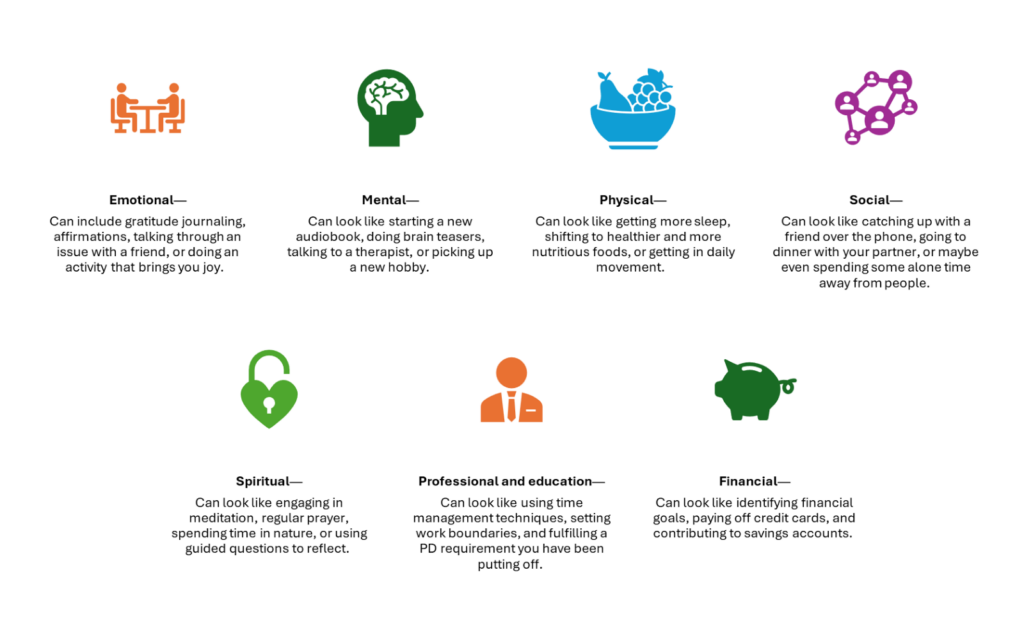
One of the important aspects to acknowledge around self-care is that you need to develop a plan that works for you. The University of Buffalo School of Social Work talks about how there are not “one-size-fits-all" self-care plans, but there is a common thread to all self-care plans: making a commitment to address each domain of self-care every week. Calm recommends that when creating a self-care routine, you need to start small and set reminders. For example, start with 10 minutes a day dedicated to an activity or practice that gives you joy, that could be taking a walk around the office mid-way through the day, doing a couple word puzzles to start the day, writing three things you are grateful for that day, or calling someone you love after dinner. If you need to, hold yourself accountable by setting reminders on your phone or writing them in your planner. Self-care can require intentionality. The Healing Trust, a nonprofit working towards creating more equitable outcomes for families, created a Self-Care Planning Guide for Individuals that is a great tool to guide you through establishing your personal plan. The plan helps you build up to creating a whole self-care day and making self-care a habit. Individual self-care can help professionals and advocates that work with families prevent and mitigate the negative effects of compassion fatigue, making it compelling to find a self-care plan.
To make self-care a part of your work practice, as a supervisor or team member, you make want to recommend incorporating well-being check-ins. The University of Utah Accelerate Learning Community discusses how using check-in questions during meetings, team huddles, and hand-offs can help team members reconnect to their purpose, be more present and focused, and feel connected. They coined the term Wellness Champions as those who provide opportunities and spaces for professionals and advocates to process events and experiences in a productive way. Also, having regular check ins can be a way to boost overall morale and provide a space where people can alleviate some of their mental load by sharing pressing professional concerns with like-minded peers. The University of Utah provides a check-in guide that contains sample questions and facilitation suggestions. Some of the prompting questions include:
- What is a high and low from the day?
- What is something that you want to remember or remind yourself of during your shift/workday today?
- Give a shoutout to yourself and a shout out to someone on the team.
This practice of weekly team check-ins can show professionals and advocates that they are worth taking care of and their experiences and emotions are valid. Research from The Canadian Veterinary Journal addresses how, while it is important to build resilience on a personal level, there needs to be interventions at the organizational level to maximize health and well-being for individuals. The Journal goes on to talk about how the risk of compassion fatigue cannot be eliminated, but the impact can be mitigated with organizations implementing measures that address the mental load put on individuals. These strategies also lead to overall healthier organizations that meet their mandate, achieve their goals, and remain resilient. A weekly check-in takes a step towards reducing workplace stress and providing a safe place where people are encouraged to do their job well while also making sure they are well.
Self-Care Strategy to Deal in the Moment
A part of self-care for professionals is understanding how to cope with stressful situations on the fly. Careers centered around serving and supporting families are inherently high stress jobs. It is important that professionals have the skills and presence of mind to adapt to unpredictable situations in the moment. One strategy that can be used is what Elisha Goldstein, Ph.D., refers to as the STOP method. The word STOP stands for:
- Stop what you are doing
- Take a few deep breaths
- Observe what is going on
- Proceed with, “What am I needing right now to get through this?”
When appropriate, this strategy can allow you to slow down, acknowledge what is going on in your body and mind, and be mindful about how you react to that trigger in the moment. Goldstein explains, “When we drop into the present, we’re more likely to gain perspective and see that we have the power to regulate our response to pressure.” In this way, we can gain some control and combat the effects of compassion fatigue and burnout.
Conclusion
Compassion fatigue, often described as the emotional consequences or strain of exposure to working with individuals suffering from traumatic events, can significantly impact professionals and advocates who work with families. To combat compassion fatigue, it is crucial for professionals to prioritize their mental health so they can maintain their well-being and fit for providing service to families. An unknown author said, “As helping professionals, our greatest tool is ourselves. If we are not well, we cannot do our work well.” As put by CommonHealth Virginia, compassion fatigue can be a cost to caring. As professionals, where an occupational requirement is to care for those we are serving, prioritizing practices that keep your heart and head in a place where you can still effectively contribute to positive change is essential to confronting compassion fatigue and creating a workforce of Wellness Champions.
If you have any questions or comments about the content in this Lightbulb Moment article, please get in touch with our Research Lead, Madeline Attianese, at [email protected].