
Voices of North Carolina
Across North Carolina, families want a platform and opportunity to lift their voice. The Institute for Family gave them a space to share personal reflections, frustrations, and hopes about what it means to be a family in North Carolina right now. Through their words, we find not only lived expertise but direction for how communities, systems, and leaders can do better. From counties across the state, respondents gave us a fuller picture of their needs and experiences.
In Buncombe County, after the aftermath of the devastating Hurricane Helene, a parent speaks to the quiet toll of disconnection:
“The unavailability of our recreational areas has been a harder thing to deal with than we anticipated. You don't tend to focus on that when all the other things seem so much more important and pressing—the safety of your house, having water, etc. But having all the rec parks and trails and dog parks and sports fields being impacted is hard too.”
In Washington County, that same need for connection echoes in a parent’s reflection:
“One change that would help my family thrive is having more community spaces for connection and support. Life gets busy, and sometimes it feels like everyone is just trying to keep up. If there were more affordable family activities, mental health resources, and safe spaces where people could come together, it would make a huge difference. Sometimes, all we need is a place to unwind, talk, and feel supported…”
These families’ sentiments remind us of the holistic nature of well-being, that for families to thrive, there must be an emphasis on having spaces to recharge, connect, and simply breathe.
In addition, families also speak to the weight of daily demands. One Washington County resident puts it plainly:
“Juggling the demands of work, household responsibilities, and quality time with family members can be overwhelming, especially as we strive to maintain a healthy work-life balance.”
In Brunswick County, the financial strain is clear:
“With the rising cost of living and stagnant incomes, effectively managing our finances and ensuring we have enough savings for emergencies and future expenses is a significant challenge.”
Housing instability also looms large, especially in Burke County, where a resident shares:
“We need more truly low-income or income-based housing options. There's a lot of poverty and a lot of unhoused folks in my area. Folks are barely scraping by.”
When families do seek help, many feel unseen or unheard. In Guilford County, someone says simply:
“Faster, more efficient services.”
And in Ashe County, a community member reminds us that listening isn’t just a polite act—it can be a transformative one:
“I think that if the community listened to hear and not listened to respond that would help a lot—especially the elected officials and the doctors, etc., that make the big decisions on what is good and not good for the county.”
Meanwhile, in Alleghany County, a parent puts forward a gentle but radical proposal:
“Normalize seeking and speaking about parenting concerns.”
These are just a handful of the responses we received through our 2025 Family Insight Survey. Through each concern, recommendation, and desire for a better future, families across North Carolina have provided us with reflections of larger systemic patterns that touch families in every county, from the mountains to the coast. They want to feel safe. To be heard. To have a place to go. To be able to afford to live. And to raise their children in communities that care. Sometimes it can be easy to forget behind the data, there are real people living and breathing the numbers that there are testimonies, like these, that can ground us in perspectives that show us how real the effects are.

Want updates on upcoming Lightbulb Moment articles?
2025 Family Insight Survey Results
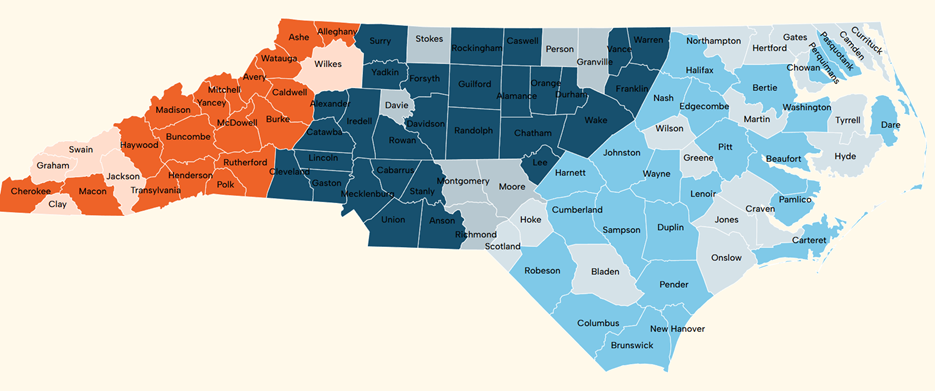
In 2023, we launched the pilot version of the Family Insight Survey, which led to the creation of the Family Insight Dashboard, a place where the nexus of data, insights, and stories come together to begin to piece together the puzzle of family life on a county basis in our state. In our pilot year, we had responses from 52 out of the 100 counties in North Carolina (shown in Figure 1). In 2025, with targeted marketing efforts, especially in Eastern and Western NC, we were able to increase responses to 71 out of the 100 counties (shown in Figure 2). Between both years, we are missing insights from only 19 counties.
Figure 1: 2024 County Responses.
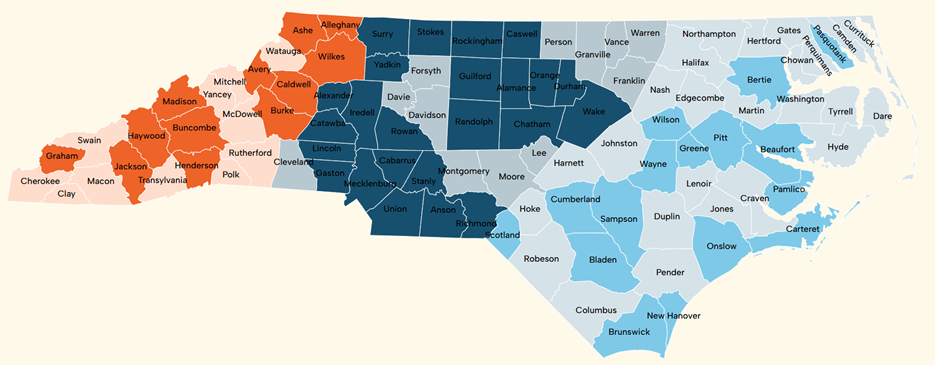
Figure 2: 2025 County Responses.
While not representative, the Family Insight Survey acts as a compelling inside view of how families are feeling across the state of North Carolina. In the survey, we ask three open ended questions that are included on the ‘Insights’ tab of our Family Insight Dashboard:
- What is going well with your family right now?
- What are challenges your family is facing right now?
- What would be one change to your community that would help families thrive?
This year, we went through all the statements received by respondents from these three questions and analyzed the qualitative data through the social determinants of health (SDOH) lens. We divided statements into the following five categories that the U.S. Department of Health and Human Services (HHS) complies with:
We used DHHS guidelines for how we categorized data. Education access and quality statements included commentary about early childhood education, educational attainment, school quality, and continued education. Health care access and quality statements included commentary on health insurance, access to doctors and preventative services, availability of hospitals and clinics, and health literacy. Neighborhood and built environment included commentary on housing quality, crime and violence rates, access to transportation, infrastructure and environmental conditions. Social and community context included commentary on social cohesion, discrimination and equity indicators, civic participation, and support systems. Finally, economic stability included commentary on income, employment, food security, housing stability, and access to financial services.
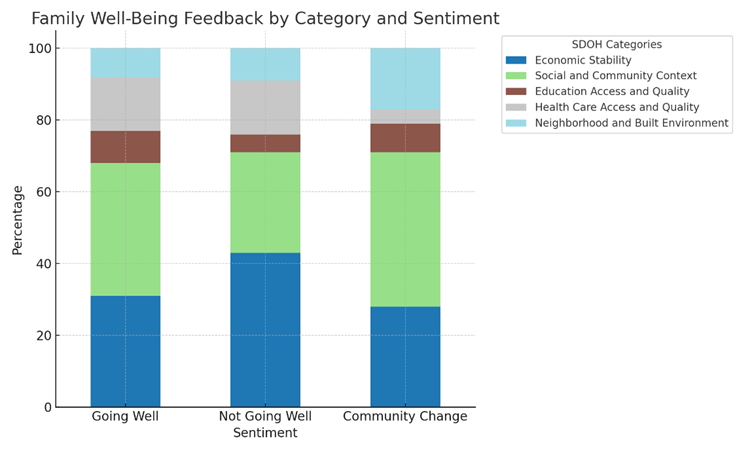
In Figure 3 and Table 1, you can see how each question faired within the SDOH categories. Economic Stability and Social and Community Context were of high priority when it came to what was going well, not going well, and community changes families would like to see. Social and Community Context emerged as the area where families are both thriving, but also desiring the most improvement, which shows us that it is a strength of families but also somewhere families feel has untapped potential for strengthening family well-being. Economic Stability was the top category for what families identified as not going well, with almost half of respondents identifying this as an area of struggle. This indicates families are feeling the pressure of financial burdens. Education Access and Quality ranked low across the board, which could mean that it is generally an area of stability OR it is not seen as a place of urgency in comparison to other daily issues and challenges.
Figure 3: Community Changes.
Table 1. SDOH Categories for Survey Questions
| Economic Stability | Social and Community Context | Education Access and Quality | Health Care Access and Quality | Neighborhood and Built Environment | |
| Going Well | 31% | 37% | 9% | 15% | 8% |
| Not Going Well | 43% | 28% | 5% | 15% | 9% |
| Community Change | 28% | 43% | 8% | 4% | 17% |
Overall, the data shows us that families see all categories as essential to well-being in some way, with every category needing improvement to allow families to thrive. Considering the interconnectedness of each category, aligning efforts that engage all sectors of well-being could provide sustainable, meaningful change for North Carolinians.
Next Steps
While the Family Insight Survey will remain a yearly staple for the Institute for Family and we will release a report each year to capture key findings, we have decided to have the open-ended questions available year-round. Life can change in an instant, meaning families’ perspectives and requirements for what they need to thrive can change frequently, too. With every voice we capture, we gain further insight into the complex and diverse needs of families across North Carolina. To gather those perspectives, though, we need the support and participation of people like you. To be a part of our Family Insight Survey and Dashboard, you can do the following:
- Share your insights into our shortened, evergreen version of the survey. Every voice gives us a new piece of information to add to the mosaic of family life in our state. Use our Family Insight Survey as a safe, anonymous space to share your triumphs, struggles, and what you would like to see change in your community.
- Send the shortened survey to your network. Consider becoming an ambassador for our Family Insight Survey. Would you be interested in partnering to promote our survey to your network? We are looking to get responses in counties we are still missing voices from: Swain, Clay, Davie, Person, Granville, Montgomery, Moore, Hoke, Jones, Craven, Hyde, Tyrrell, Martin, Northampton, Hertford, Gates, Chowan, Camden, Currituck.
Send a message to our Research Lead, Madeline Attianese, [email protected] if you would like to receive more information about promoting our survey to your network.
- Subscribe to our newsletter to keep up to date on new insights and when the full survey will be conducted again for participation. We have a monthly newsletter that highlights essential projects and important information regarding the Institute for Family.
The Family Insight Survey operates under the belief that while professionals have expertise in serving families, families are the greatest stakeholders in their own well-being and therefore deserve a space to share their strengths, worries, and hopes; families know what families need. These voices aren’t just data points, they are direction. They show professionals’ families identified strengths, what’s not working, but also what’s possible if we take the time to listen. If we truly want to strengthen family well-being across North Carolina, we must start by honoring stories like these.