
About the Expert Insights Series: The success of families depends on many stakeholders coming together to understand and respond to the complex needs of families. With so many facets of family well-being and endless commentary on topics, it can be difficult for professionals to find the reliable, relevant information they need to make informed decisions and stay current on key issues.
That’s why we created the Expert Insights Spotlight. This is a space where we talk to trusted experts across the many fields that contribute to flourishing families. These conversations offer actionable insights and digestible advice for professionals, advocates, and anyone working to support family well-being.
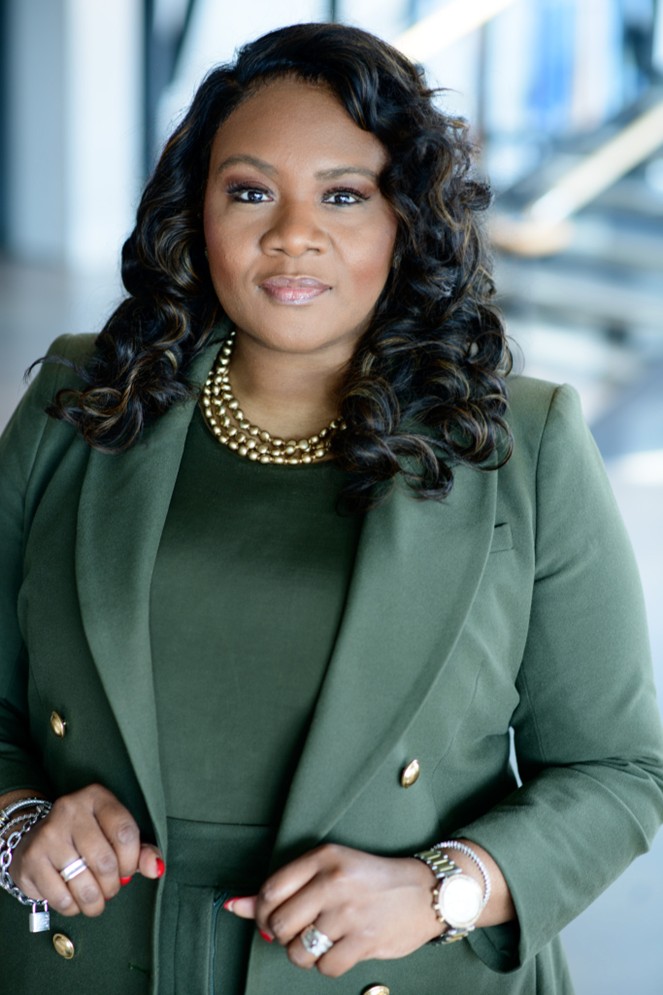
She previously served as COO of the Urban League of Central Carolinas, securing over $1M in funding and expanding workforce development and college readiness initiatives. Her leadership roles with Charlotte-Mecklenburg Schools and federal agencies have focused on advancing equity, engagement, and support systems for students and families.
In addition to her professional accolades, Dr. Shaw is a member of Leadership Charlotte, the African American Leadership Academy, and Delta Sigma Theta Sorority, Inc., and active in her church, advocating for social justice, housing, and education. She is married to retired Marine, is a proud mother, sister and aunt. She lives by the words of Dr. Martin Luther King Jr.: “Intelligence plus character—that is the goal.”
Traditional forms of family involvement, such as telephone trees, booster clubs, and volunteering for field day, have long played a vital role in connecting families to schools. Yet for many of today’s busy families, these opportunities can feel out of reach. But what if the most meaningful engagement doesn’t depend on being physically present at school? What if it’s rooted in communication, collaboration, shared learning, and capacity building, placing children and families at the heart of the educational experience?
Imagine strategies that welcome and empower a diversity of families, fostering student success and strengthening schools for everyone. Dr. Fahnie Stewart Shaw invites us to explore this possibility. Her journey began with the example set by her own family, growing up in South Carolina—a foundation that continues to shape her vision for inclusive and impactful family engagement.
Setting the Scene
Dr. Fahnie Stewart Shaw’s journey into education began not in a classroom, but in her own living room. Raised by two school administrators, her childhood home was a hub for community, or as she describes it a “mini-PTA.” Kids and families would gather in their home, ideas would flow, and service was a way of life. She and her siblings saw every day that their parents were not just educators, they were community leaders and builders. Her father, once a successful businessman climbing the corporate ladder, felt the pull of public service, joining a family legacy of lawyers, educators, and civic leaders. In addition to her educational duties as a school administrator, her mother helped establish a Jack and Jill chapter in a place that didn’t have one in South Carolina, creating a space for Black families to connect and grow. Whether through church, school, or neighborhood outreach, Dr. Shaw’s parents modeled what it meant to create conditions where everyone had what they needed to succeed.
While Dr. Shaw initially pursued international business, the call to serve was coded in her DNA. Eventually, she found herself in the place where she was meant to be: fostering strong partnerships between schools, families and communities as the Community In Schools Chief Operating Officer. Communities In Schools works to champion strong family-community-school partnerships by embedding support directly within schools, helping students and families access critical resources and building lasting connections. Every day, she advances a vision of education rooted in equity, dignity and collective well-being. Dr. Shaw said, “Being in the service space and because of our family, I understand how essential families are and how that advocacy, perspective, and social capital empowers you and leads you to overall well-being.”
Importance of Family Engagement
In education and community life, one truth rises above the rest: families are the cornerstone of a child’s success. When schools, families, and communities work in partnership, they don’t just support academic outcomes, they build environments where families can thrive for generations.
As Head Start defines it, family engagement in schools is: “a shared responsibility of families and staff at all levels that requires mutual respect for the roles and strengths each has to offer.” This engagement can look like parent-teacher conferences, volunteering in classrooms, or attending PTA meetings. But as Dr. Shaw reminds us, it doesn’t always mean being present at every event. Being present for your child’s education is a long journey that starts with engagement at home. This is especially important since most parents work every day, sometimes working multiple jobs. Many parents have schedules that prevent them from engaging in-person at school. Dr. Shaw assures us that this is okay.
“Parents should feel empowered to say to their child’s teacher, ‘I am not a parent that will show up to everything.’ They should communicate and let teachers and schools know how they are best to be contacted, and they should also learn ways to support learning at home and be impact reinforces in positive behavior.” She explains that this kind of communication is powerful: “It’s also a recourse for both parents and educators because it lets someone know, hey, this person cares, but also sets the standard of how you can engage and support.” Teacher-family communication is a powerful engagement strategy especially as it relates to student success. Research from Kraft and Dougherty explains the significance furthermore in saying it’s linked to better homework completion, class participation, as well as improved teacher-student interactions and student motivation.
The research is clear: when families are engaged, children thrive. EdTrust, analyzing surveys of 600 parents and 300 teachers, found that strong family-school partnerships are linked to higher literacy and math skills, better graduation rates, increased college attendance, and improved overall student outcomes. Yet as Dr. Shaw points out, true engagement goes deeper than attendance and metrics. “I think a lot of it is finding out what families really want and need. And sometimes that means asking questions in a way that makes them feel safe to share honestly. Engagement starts with listening.”
Former U.S. Secretary of Education Arne Duncan echoed this sentiment when he urged schools to treat parents as “real partners in education, from cradle to career.” Families and teachers, he argued, are co-creators of accountability and student success. Dr. Shaw echoes this perspective on integrated support systems, offering a compelling perspective on how these partnerships must be rooted in genuine connection and sustained support. As Dr. Shaw puts it: “It’s not enough to invite families to the table—we have to make sure they feel like it’s their table too.”
Dual-Capacity Building Framework
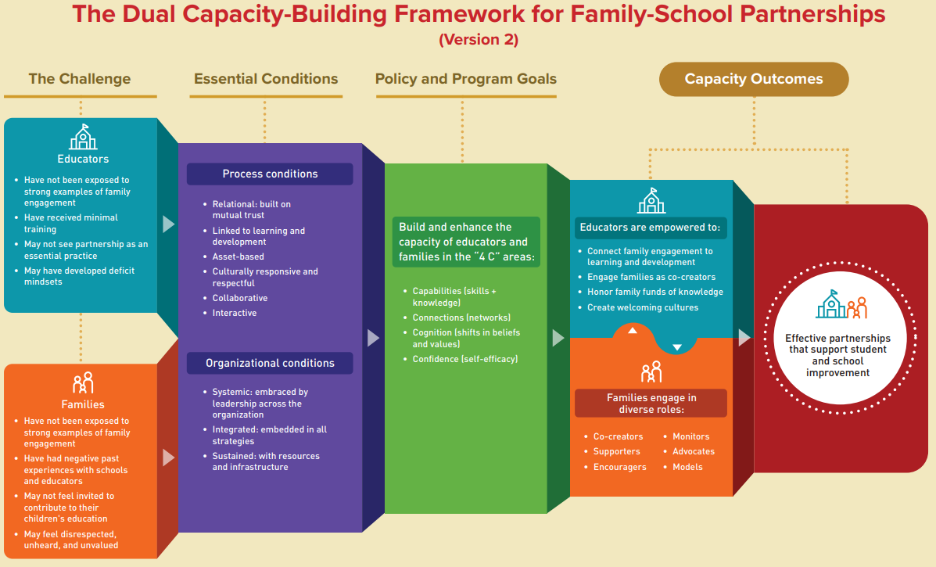
To translate ideas into action, researchers and practitioners have turned to guiding frameworks. Education Elements explains how guiding frameworks are essential in education because they provide “alignment around critical goals, which can positively impact teachers, students, parents, and the community.” One of the most influential is the Dual Capacity-Building Framework for Family-School Partnerships, developed in 2013 by Dr. Karen Mapp with support from the U.S. Department of Education. The success of the framework rests in its ability to set out the conditions necessary to chart a path towards the type of family engagement that leads to student achievement and school improvement.
The framework highlights:
-
- The capacity challenges schools and families face in building partnerships.
-
- The conditions necessary for initiatives to succeed.
-
- Intermediate goals for engagement policies.
-
- Capacity-building outcomes for both educators and families.
Dr. Shaw notes how this framework acknowledges the strengths families already bring: “You build and you enhance, and you recognize parents and families are capable. They have skills and knowledge… they have connections… they have beliefs, and they also have value.” In other words, schools must see families not as passive participants, but as skilled partners with unique assets to share. The Dual Capacity-Building Framework recognizes families are essential drivers of student success and community well-being and gives us strategies and tools to make it a reality.
The graphic below summarizes the framework in an easy-to-follow-along format:
Relational Capital
True engagement is nuanced. Dr. Shaw stresses that it should never be reduced to a checklist or a single framework. It’s about building what she calls relational capital. Here, the Developmental Relationships Framework from the Search Institute offers another lens.
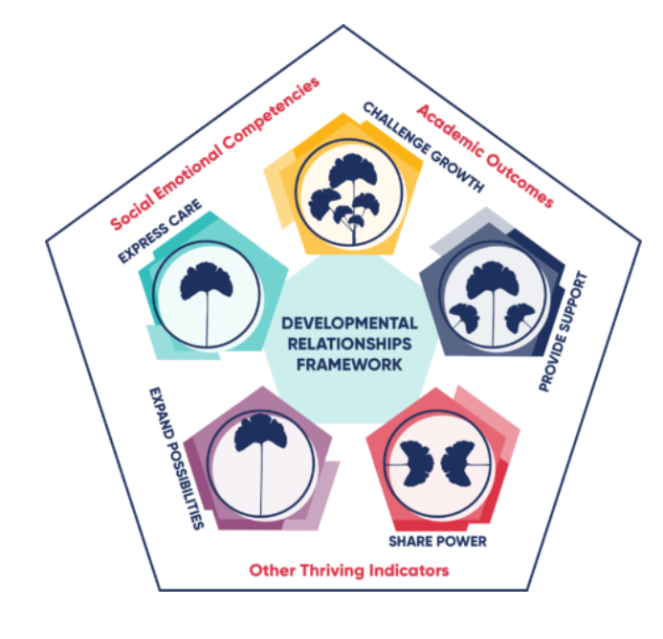
The framework identifies key elements—expressing care, challenging growth, sharing power, and expanding possibilities—that foster resilience and help children thrive. The five key elements of the framework shown in the graphic above are explained in detail on the Search Institute website. Below, we’ve included their summarizing statements for reference:
-
- Express Care: Show me that I matter to you.
-
- Challenge Growth: Push me to keep getting better.
-
- Provide Support: Help me complete tasks and achieve goals.
-
- Share Power: Treat me with respect and give me a say.
-
- Expand Possibilities: Connect me with people and places to broaden my world.
Search Institute created the framework to help anyone who works with youth, whether that be their families, schools, programs, or community members, to understand the current state of their relationships with young people and how they can nurture them to support their ability to grow and flourish. Research confirms that developmental relationships are critical across age, race, and socioeconomic background, enabling young people to “discover who they are, cultivate the ability to shape their own lives, and learn how to positively contribute to the world.” The Developmental Relationships Survey can provide a baseline for seeing the level of support and guidance young people perceive from adults in their lives.
Dr. Shaw reflects: “Making sure that people just really get good at developmental relationships is going to be key… showing concern, expanding possibilities, sharing power, and challenging growth.”
“Systems should wrap around families”
For Dr. Shaw, strong frameworks are only effective if they translate into systems that meet families where they are: “The systems we create should wrap around families, not make them feel like they have to fit into a box to receive help.” Support, she explains, looks different for every family. “For some, it’s resources. For others, it’s simply knowing they have someone in their corner.” This flexibility requires humility and courage from educators and leaders:
“We have to have the courage and the humility to show up and be in the space of discomfort and tension and also joy and healing and freedom that comes with the truth. The truth doesn’t have to be pretty, but it has to be told.”
Family engagement, then, isn’t about assimilation. It’s about honoring diversity. As Dr. Shaw says, “We’re not doing melting pot work, we’re doing mosaic work… So, everyone has their piece to bring, everyone has their assets to bring.” When schools, communities, and families invest in these partnerships, the impact multiplies. “The return on investment is multi-generational and also exponential,” Dr. Shaw emphasizes. By supporting parents and caregivers today, we shape healthier, more resilient communities for decades to come.
This work extends beyond schools. “Who can be the extension of the family? That’s where community I really feel comes in.” Whether through neighborhood organizations, faith communities, or local programs, partnerships thrive when they are holistic and inclusive. Parent-Powered explicates how “education doesn’t happen in isolation. Schools that embrace their surrounding communities as partners in education unlock a world of possibilities for their students.” This may look like introducing local guest speakers and mentions, community career exploration opportunities, or local organizations helping fill resource gaps.
When everyone recognizes their role in elevating the educational experience of our children, we lay the foundation for a future built on collective responsibility and meaningful relationships.
Conclusion
When asked about where she sees the future of family-school partnerships over the next five years, Dr. Shaw’s response was filled with hope and conviction for the integral role it will play: “I do think we are at the space now where schools will have to invest if they want to make sure that they are wildly successful… We might even see ourselves getting back to really having true social workers, guidance counsellors—like having the trifecta in schools.”
One thing is for certain, as Dr. Shaw pointed out herself: it truly takes a village to support families today and set the foundation for the success of future generations. Her call to action for deeper investment in holistic support roles and infrastructures puts family engagement at the center of school success and community well-being.
Most importantly, she frames the work of family and community engagement as a collective responsibility and extends an invitation to step beyond collaboration toward shared ownership of solutions. “We are shifting now to a collective space… This is not just collaboration. You can call out a problem, but we need you to be a part of the solution. That’s where collectivism is totally different. I need you to see that your liberation is tied to mine.”
When we choose to invest in partnerships built on trust, respect, and shared responsibility, we do more than strengthen families in the present, we lay the foundation and conditions for generations to flourish. As Dr. Shaw put it, “Children are at the center of everything, but family is at the apex.” When schools and communities honor this truth, the path forward is one of promise: supporting families is the surest way to elevate every child and create futures where we all can thrive alongside our children.